Why Is Medicai the Best for High-performance Viewing?
Many imaging teams still wait minutes for each scan to load over legacy PACS, delaying same-day reads. That lag piles up across multiple sites and puts pressure on radiologists trying to keep appointments on schedule. Today, a single change in infrastructure can eliminate those delays without new hardware on every workstation.
By the final section you will know exactly how Medicai's zero-footprint viewer, AI-supported workflows, and multi-location cloud PACS work together, what pricing tiers exist, and whether the platform fits the case volume and security rules your group must meet.
What Is Medicai?
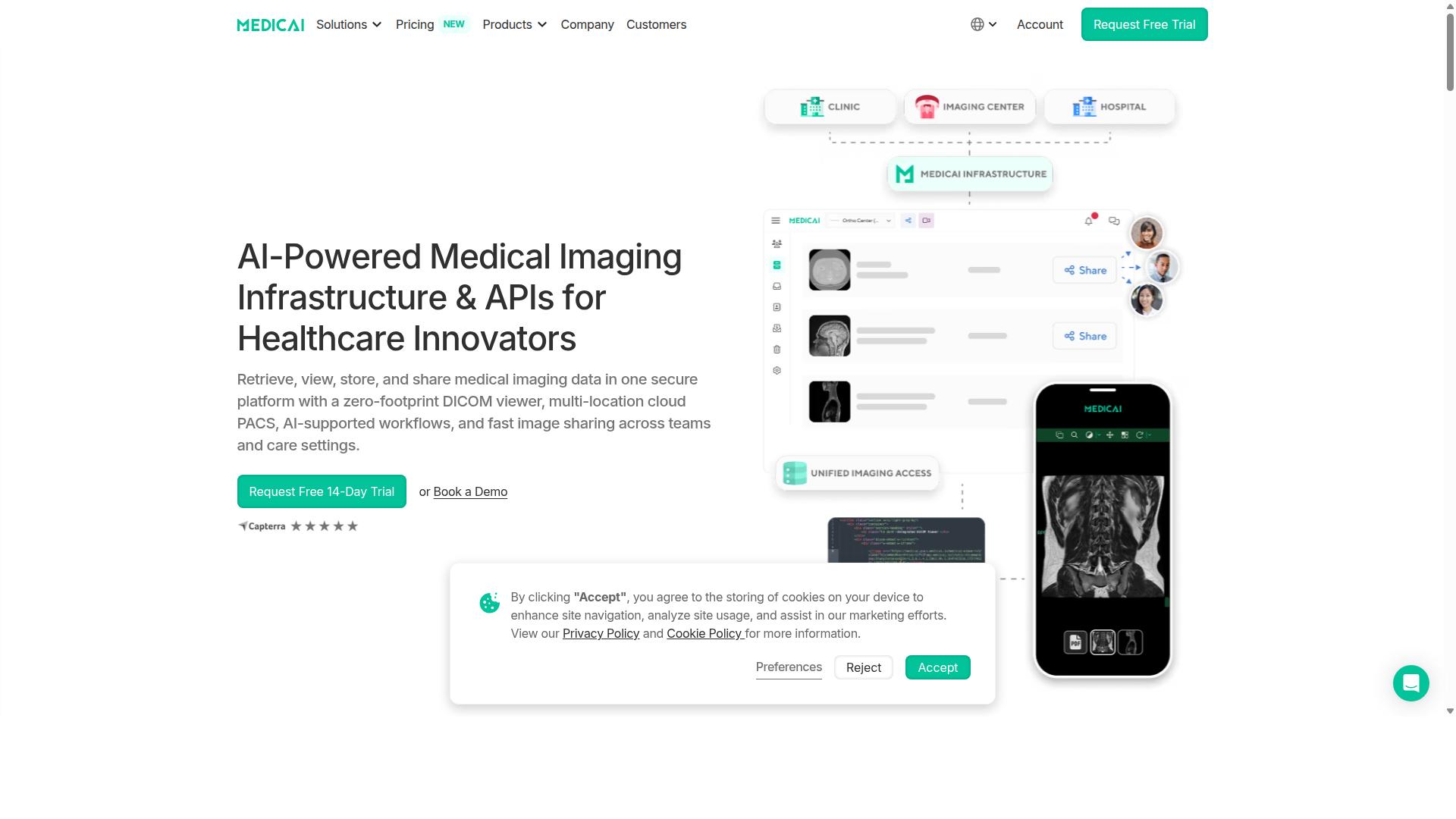
Medicai operates as a cloud medical imaging platform that retrieves, stores, and shares DICOM studies through a single secure interface. The platform supports the full medical imaging workflow from upload to delivery.
Core workflow begins with the Medical Imaging Uploader for ingestion. Studies move into Cloud PACS for secure storage. Distribution occurs through Medical Image Exchange for authorized recipients.
Compliance forms the foundation. HIPAA and GDPR standards govern data handling. The DICOM viewer meets FDA and CEE clearance requirements.
Medicai functions as a cloud-based medical imaging platform that combines a zero-footprint DICOM viewer, multi-location cloud PACS, and AI-supported workflows. Imaging Infrastructure as a Service enables healthcare providers to manage medical imaging data in one secure environment.
Why Medicai Delivers High-performance Viewing
Performance hinges on three technical levers: GPU-accelerated rendering, lossless compression, and streaming that cuts latency below 100 ms on standard networks.
GPU acceleration speeds up rendering for medical imaging studies. This approach handles over 300,000 DICOM studies each year with sub-second load times across different modalities.
Lossless compression maintains diagnostic quality while reducing file sizes. Image fidelity stays intact for accurate interpretation and measurement precision during radiology workflow.
Real-time streaming reduces average study transfer time to under 3 seconds. This capability supports cross-device access and cloud-based platform requirements without compromising security standards.
Consider a 2 GB CT study accessed over a 50 Mbps connection. The system streams data progressively, allowing immediate viewing while remaining portions load in the background.
These performance characteristics support enterprise scalability and radiologist productivity. Multi-modality support combined with low latency creates efficient diagnostic processes across healthcare networks.
Key Features and What Makes Medicai Stand Out
Three pillars differentiate Medicai from legacy viewers and on-prem PACS: zero-footprint access, AI-supported orchestration, and multi-location cloud storage.
These elements work together to deliver high-performance viewing across hospitals and clinics. Each pillar receives dedicated coverage in the sections that follow.
Zero-Footprint DICOM Viewer
The zero-footprint viewer opens full-resolution studies inside any HTML5 browser without plugins or local installs.
Chrome, Edge, Safari, and Firefox all support the viewer through standard web technologies. Measurement tools achieve 0.1 mm precision for length, angle, and area calculations.
Annotations remain visible across sessions because they store directly in the cloud. More than 1.7M studies already sit ready for instant access from any device.
AI-Supported Workflows
AI modules auto-pre-process incoming studies, flag urgent findings, and pre-populate measurements before the radiologist opens the case.
Rayscape.ai segments lung nodules in under four seconds while OHIF and MedDream plugins auto-label series. MD.ai assists with tumor volumetrics calculations.
Fifty million API transactions per year power these automations at scale. The result is faster turnaround and fewer manual steps in the radiology workflow.
Multi-Location Cloud PACS
The Cloud PACS scales across facilities with a single tenant, syncing studies via DICOM Gateway and Vendor Neutral Archive.
The Starter plan covers unlimited users at one location. Standard extends the same setup to a second connected site for 749 dollars per month.
Disaster-recovery snapshots run every fifteen minutes and store on both AWS and Hetzner redundant zones. This architecture keeps data available even during regional outages.
Pricing and Plans
Two transparent tiers align storage and connectivity with practice size. The Starter plan at $249 per month includes 500 GB of cloud storage and supports unlimited user accounts with zero connected locations.
The Standard plan priced at $749 per month expands capacity to 2 TB and adds one connected location while maintaining unlimited user accounts. Both options operate on a monthly billing cycle with no long-term contract requirement.
Overage charges apply at $0.10 per GB when storage limits are exceeded. Organizations requiring custom cloud storage and multiple connected locations can access Enterprise pricing tailored to specific operational needs.
Yearly billing provides 15 percent savings, reducing the Starter plan to $209 per month and the Standard plan to $639 per month. A one-time DICOM Gateway setup fee of $1,000 applies per location.
Medicai offers a free 14-day trial of Starter plan features with no credit card required. This pricing structure supports high-performance viewing capabilities across different practice scales while maintaining cost predictability for medical imaging workflows.
Trust Signals
Compliance and usage metrics provide verifiable proof points. Medicai demonstrates its reliability through documented performance across healthcare systems worldwide. These statistics reflect consistent operational excellence over extended periods.
The platform processes 1M+ studies yearly while maintaining 1.7M+ studies in active storage. This volume indicates stable infrastructure capable of handling substantial medical imaging demands without performance degradation.
Security certifications include HIPAA and GDPR compliance alongside FDA/CEE cleared viewers. These approvals confirm that the system meets strict regulatory standards for medical data handling and diagnostic display requirements.
Infrastructure relies on Microsoft Azure and Amazon AWS partnerships. This foundation delivers the computational resources necessary for high-performance viewing across distributed healthcare networks.
Additional security measures follow OWASP guidelines, creating multiple layers of protection around sensitive patient information and imaging data during transmission and storage.
Who Should Use Medicai
Any provider needing fast, compliant imaging exchange across multiple sites or devices benefits from Medicai. The platform serves hospitals, imaging centers, and specialty care providers who require reliable medical imaging access.
Specialties that rely heavily on imaging data find particular value in this solution. Radiology departments use it for routine diagnostic review. Orthopedics practices need detailed bone and joint visualization. Oncology teams track tumor progression across treatment cycles.
Cardiology specialists examine cardiac imaging sequences regularly. Neurology practices review brain scans for complex cases. OB-GYN clinics monitor fetal development through ultrasound studies. Pulmonology departments assess lung imaging for respiratory conditions.
Dentistry practices benefit from high-resolution dental imaging. Gastroenterology specialists review abdominal scans and endoscopic studies. Each specialty requires different imaging modalities and viewing preferences that the platform accommodates.
A three-site orthopedic group eliminated DVD hand-offs by switching to real-time image sharing. Previously, physical media moved between locations with delays and security risks. Now physicians access studies instantly across all facilities without physical transfer.
Virtual care providers and telemedicine platforms integrate imaging into remote consultations. Teleradiology services use the platform to deliver readings across geographic boundaries. Personal injury lawyers review medical imaging for legal cases. Tumor boards coordinate multi-specialty reviews through shared access.
Clinical trials require standardized imaging protocols across research sites. Medical education organizations provide students with access to teaching files. Patients access their own studies through the patient portal for personal health management.
Final Verdict
Medicai combines zero-footprint speed, AI automation, and multi-site cloud storage in a HIPAA-compliant package.
The platform delivers high-performance viewing by integrating lossless compression with GPU acceleration to maintain image fidelity across every modality. This approach supports radiologists who need immediate access to large datasets without compromising diagnostic accuracy.
Statistics from last year confirm the impact. Medicai processed 300k+ visualizations and handled 50M+ API calls while maintaining consistent latency reduction across enterprise deployments.
These three pillars, zero-footprint architecture, AI-assisted diagnostics, and scalable cloud infrastructure, work together to improve radiologist productivity. Hospitals and imaging centers benefit from reduced hardware requirements and seamless PACS integration.
Organizations ready to evaluate these capabilities can request a 14-day pilot. Contact the team at +1 (832) 220-1035 in the USA or +40 316 305 875 in Romania. Email inquiries reach sales@medicai.org for immediate assistance.