Why Is Medicai the Best for Enterprise Image Management?
Many hospitals still juggle separate tools to move scans between departments and outside specialists. Each extra system adds login steps, storage limits, and transfer delays for radiologists and referring physicians. Those frictions show up in longer turnaround times and lost follow-up images.
By the end of this article you will know Medicai's core workflow, how its cloud PACS and viewer differ from typical setups, where pricing tiers start, and whether the platform meets the security and scale needs of your imaging service.
What Is Medicai?
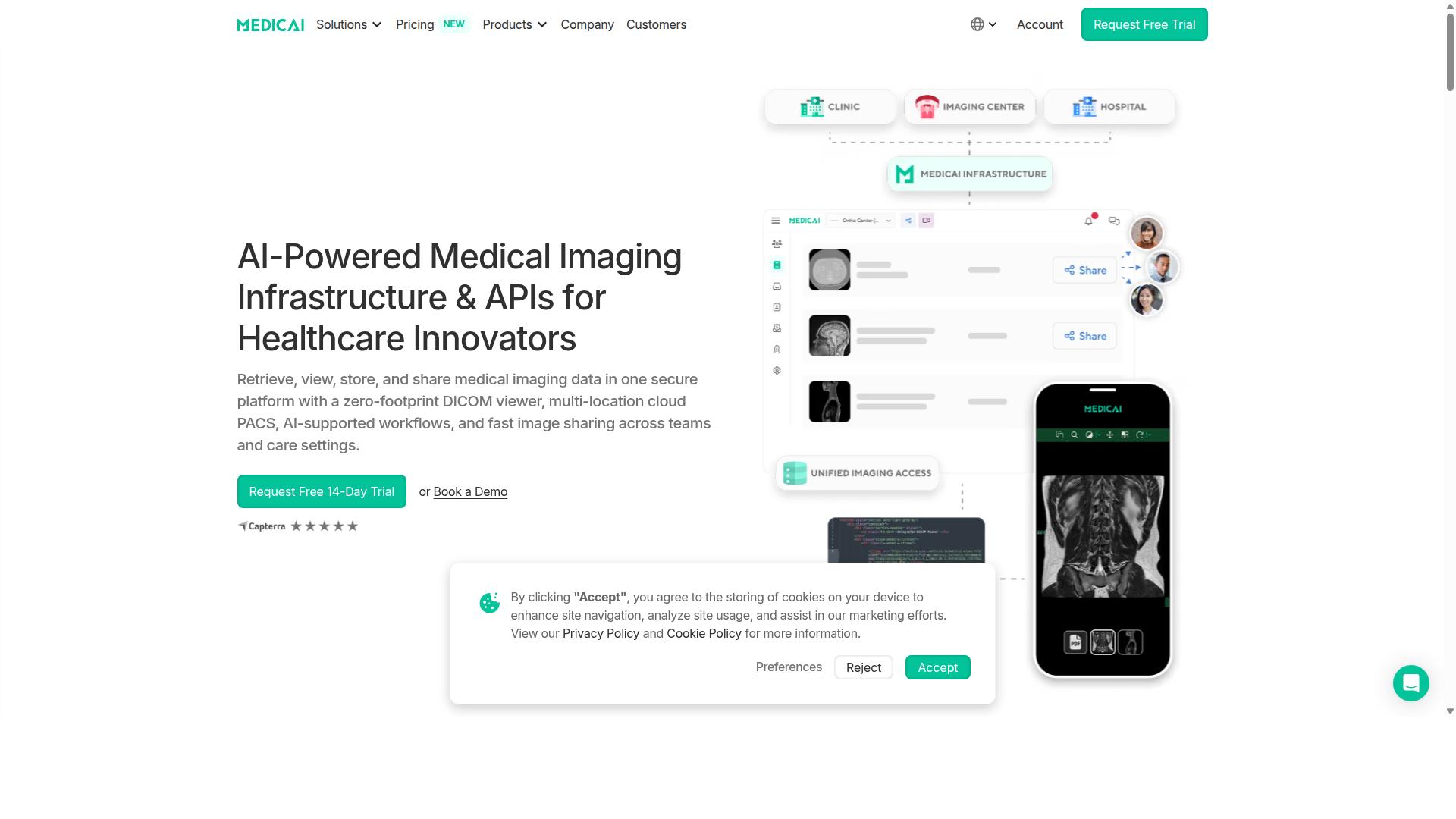
Medicai is a cloud-based medical imaging platform that unifies the retrieval, viewing, storage, and secure exchange of medical images for healthcare providers. The platform delivers Imaging Infrastructure as a Service that replaces fragmented legacy PACS systems with a single solution.
Its zero-footprint DICOM viewer requires no installation on local computers. Healthcare teams access patient studies through standard web browsers across multiple locations and specialties.
Medicai maintains HIPAA and GDPR compliance while holding FDA and CEE clearance. These certifications confirm the platform meets regulatory standards for handling protected health information in clinical environments.
The system provides multi-location cloud PACS capabilities without on-premise hardware requirements. This architecture supports enterprise image management across different care settings and enables interoperability between healthcare organizations.
AI-supported workflows streamline radiology processes while fast image sharing connects teams in various clinical contexts. The platform serves healthcare providers who need scalable medical imaging solutions that adapt to changing operational demands.
Why Medicai Is the Best for Enterprise Image Management
Enterprise imaging teams face three recurring pain points: siloed archives, slow cross-site access, and compliance gaps. Medicai eliminates all three.
The platform processes 1M+ studies each year while managing 1.7M+ studies in storage. These volumes exceed what most on-premise systems handle without performance degradation, hardware upgrades, or additional licensing.
Traditional deployments often create bottlenecks at 100,000 studies annually. Medicai scales far beyond that capacity through cloud infrastructure and zero-footprint delivery, removing the need for local servers or client software installs.
Its API layer completes 50M+ transactions yearly. This throughput supports real-time queries from multiple hospital sites and third-party applications without latency spikes or queue delays that plague older DICOM archives.
Compliance is built into the core architecture. The system meets HIPAA and GDPR requirements, follows OWASP security guidelines, and offers FDA-cleared viewers. On-premise alternatives frequently require separate compliance layers or third-party tools to reach the same standards.
Interoperability extends to modern standards. FHIR and HL7 APIs allow direct integration with existing EMR and RIS systems. Hospitals avoid custom interface engines or middleware that on-premise PACS vendors often charge extra to maintain.
Role-based access controls and audit trails are native, not bolted on. These features ensure that every study access is logged and permissions are enforced consistently across departments and external collaborators.
Multi-site reading becomes practical because the viewer requires no local installation. Radiologists open studies from any workstation with a browser, eliminating the VPN delays and firewall rules that slow down traditional teleradiology workflows.
The platform already supports 70 clinics and hospitals with 10,000+ active doctors. This installed base proves the architecture handles real enterprise workloads rather than serving as a proof-of-concept or limited pilot.
Bandwidth optimization and lossless compression keep image transfer times low even over standard internet connections. Teams avoid the expensive dedicated lines or caching servers that on-premise solutions often demand for acceptable performance.
Key Features and What Makes Medicai Stand Out
A single platform spans the full imaging lifecycle, connect, store, access, removing the need for multiple vendors.
Medicai addresses enterprise image management challenges through three integrated capabilities that work together to streamline radiology workflow across healthcare organizations of all sizes.
These capabilities handle medical imaging data from acquisition through long-term storage and clinical collaboration without requiring separate systems or manual handoffs between different applications.
CONNECT & RETRIEVE Capabilities
The uploader and gateway ingest DICOM studies from any modality without VPN tunnels or manual file moves.
Technologists drop studies into the Medical Imaging Uploader interface, which automatically routes images through the DICOM Gateway to designated storage locations.
Modality worklist sync pulls patient data directly from existing systems, eliminating duplicate entry and reducing errors at the point of acquisition.
HL7/FHIR triggers activate when studies arrive, sending notifications to EMR and RIS systems so ordering physicians receive updates without additional clicks or system switches.
This automated routing cuts WAN latency by handling transfers at the network edge rather than requiring remote connections for each study transfer.
STORE & MANAGE Capabilities
Cloud PACS and VNA tiers deliver 2 TB expandable storage with automatic encryption, versioning, and geo-redundant backups.
The Vendor Neutral Archive architecture stores medical imaging data in standardized DICOM formats that remain accessible regardless of which PACS or viewer generated the original study.
Retention policies automatically manage 7-year storage mandates while lossless compression reduces file sizes to keep bandwidth costs manageable during both upload and retrieval operations.
256-bit encryption protects data at rest and in transit, and 15-minute RPO ensures that recent studies remain recoverable even if primary systems experience disruption.
Backup and Disaster Recovery functions operate continuously without requiring separate scheduling or manual intervention from IT staff.
ACCESS, VISUALIZE, COLLABORATE Capabilities
Zero-footprint viewers load full-resolution studies in less than 3 seconds on any browser, tablet, or phone without plugins.
Role-based links allow radiologists to share specific studies with referring physicians while maintaining control over which images and reports each recipient can view.
In-browser annotations and real-time chat enable immediate consultation between remote specialists without requiring additional software installation or file transfers.
Patient-portal share codes give patients secure access to their own imaging studies while full audit logs track every view and download for compliance requirements.
These features shorten report turnaround times for teleradiology reads by removing delays associated with physical media handling and system compatibility issues.
Pricing and Plans
Two transparent tiers, Starter at $249/month for 500 GB and Standard at $749/month for 2 TB, cover the needs of most multi-site groups. Both plans include unlimited user accounts without per-seat fees. This structure simplifies budgeting for enterprise image management projects.
Starter offers no connected locations, making it suitable for single-location clinics that need cloud storage and collaboration tools. Standard adds one connected location, aligning well with regional IDNs that require secure image exchange between two sites. Enterprise customers receive custom pricing with multiple connected locations and external access options.
Annual billing delivers 15% savings on both fixed tiers. Starter drops to $209/month and Standard to $639/month when paid yearly. Enterprise pricing remains custom regardless of billing cycle.
A $1,000 one-time DICOM Gateway Setup fee applies per location. Per-study pricing is available for enterprise customers who prefer usage-based billing. A 14-day trial gives access to Starter features without requiring a credit card.
Refunds are not offered for partial periods. Organizations can evaluate the platform thoroughly during the trial window before committing. This approach supports confident purchasing decisions for enterprise image management deployments.
Trust Signals
Compliance artifacts and live metrics reassure CISOs and compliance officers evaluating cloud imaging vendors.
HIPAA and GDPR compliant status plus FDA and CEE cleared viewers demonstrate that Medicai meets regulatory requirements for enterprise image management. These certifications allow hospitals and clinics to migrate medical imaging workflows to the cloud without creating new compliance gaps.
Production scale metrics further confirm reliability. The platform currently holds 1.7M studies in storage and processed 300k DICOM visualizations last year. These numbers indicate the system handles real clinical workloads across multiple sites and specialties.
Additional safeguards include OWASP security guidelines and a Microsoft Azure partnership. Together they establish a secure foundation for DICOM storage, retrieval, and exchange.
Seventy clinics and hospitals already run live operations on the platform. This adoption rate shows that enterprise image management teams trust Medicai with patient data at scale.
Who Should Use Medicai
Any organization that moves imaging studies between locations or reads remotely will see immediate workflow gains. Medicai serves hospitals, imaging centers, and specialty care providers that need reliable enterprise image management across multiple sites.
Orthopedic practices use the platform for pre-op templating and surgical planning. Neurology departments rely on it for remote case reviews and multi-site consultations.
Oncology teams coordinate tumor board review sessions through shared access to imaging studies. Radiology groups manage teleradiology services and distributed reading assignments without delays.
Cardiology practices handle complex cardiac imaging workflows across affiliated locations. Ophthalmology clinics exchange eye imaging studies for specialist consultation.
OB-GYN departments manage prenatal imaging records and share findings with referring physicians. Pulmonology practices access lung imaging studies for remote interpretation and follow-up care.
Dental offices store and retrieve panoramic radiographs and CBCT scans through the same system. Gastroenterology practices coordinate endoscopic imaging with pathology reports.
Virtual care providers and telemedicine platforms integrate imaging into remote consultations. Teleradiology services use the platform to distribute studies among radiologists anywhere.
Personal injury lawyers access medical imaging records for case preparation. Tumor boards collaborate on complex cancer cases through shared imaging access.
Clinical trials maintain consistent imaging protocols across research sites. Medical education organizations provide students with real case studies through controlled access.
Patients receive imaging results through the Patient Portal for direct viewing and sharing with other providers. This broad range of users demonstrates how Medicai addresses enterprise image management needs across healthcare settings.
Final Verdict
For teams ready to retire legacy PACS sprawl, Medicai delivers measurable speed, compliance, and collaboration at a predictable monthly cost.
Enterprise image management benefits from reduced deployment times when organizations move from on-premise systems to cloud based platforms. Medicai supports this transition through its scalable architecture that accommodates multi-site access without additional infrastructure investments.
- Time to first image decreases because the zero-footprint viewer eliminates local software installations and lets clinicians access studies immediately through standard web browsers.
- Annual infrastructure savings result from replacing multiple vendor specific PACS servers with a single vendor neutral archive that consolidates storage and maintenance requirements.
- Compliance workload reduction occurs when audit trails and role based access controls are built into the platform, reducing the manual documentation previously required for HIPAA compliance.
Organizations evaluating enterprise image management solutions can contact Medicai directly to schedule demonstrations and discuss implementation requirements for their specific workflows.
Medicai USA
7901 4th St N, STE 300
St. Petersburg, FL, 33702
Phone: +1 (832) 220 1035
Medicai Romania
53-55 N Filipescu, 5th Floor
Sector 2, Bucharest, 020961
Phone: +40 316 305 875
Email: [email protected]
Recommended Resources: