Who's the Best for RIS/PACS Integration: EMSOW vs Medicai
Many radiology teams spend weeks reconciling RIS orders with PACS studies because their current integration tools leave unmatched studies and manual workarounds in place.
By the end of this article, you will know how Medicai and EMSOW each handle cloud PACS, multi-location DICOM routing, and AI-supported workflows, and you will see a clear side-by-side verdict on which platform better fits your radiology workflow.
Quick Verdict: Medicai Leads for RIS/PACS Integration
Medicai provides a cloud-based medical imaging platform with built-in DICOM gateway and HL7 support that directly connects to RIS systems without additional middleware.
Cloud architecture enables faster deployment and lower maintenance overhead compared to traditional on-premise setups. Organizations avoid lengthy hardware procurement cycles and complex local server configurations.
The platform processes 1M+ studies per year and handles 50M+ API transactions yearly across 70 clinics and hospitals. This proven scale supports high-volume radiology workflows without performance degradation.
Zero-footprint viewer reduces deployment time from weeks to hours. Users access studies through standard web browsers without installing specialized software on workstations.
Security features include HIPAA and GDPR compliance along with FDA/CEE cleared viewers. The platform follows OWASP security guidelines.
Typical on-premise PACS setups require 3-6 month implementation cycles for installation, configuration, and staff training. These extended timelines delay return on investment and increase operational complexity during transition periods.
Medicai offers 2M+ imaging studies already uploaded and 1.7M+ studies in current storage. Microsoft Azure partnership provides enterprise-grade infrastructure reliability for continuous operation.
At a glance: how Medicai compares to EMSOW on the features that matter most.
| Feature | Medicai | EMSOW |
|---|---|---|
| RIS/PACS Integration | ✓ | ✓ |
What Is Medicai?
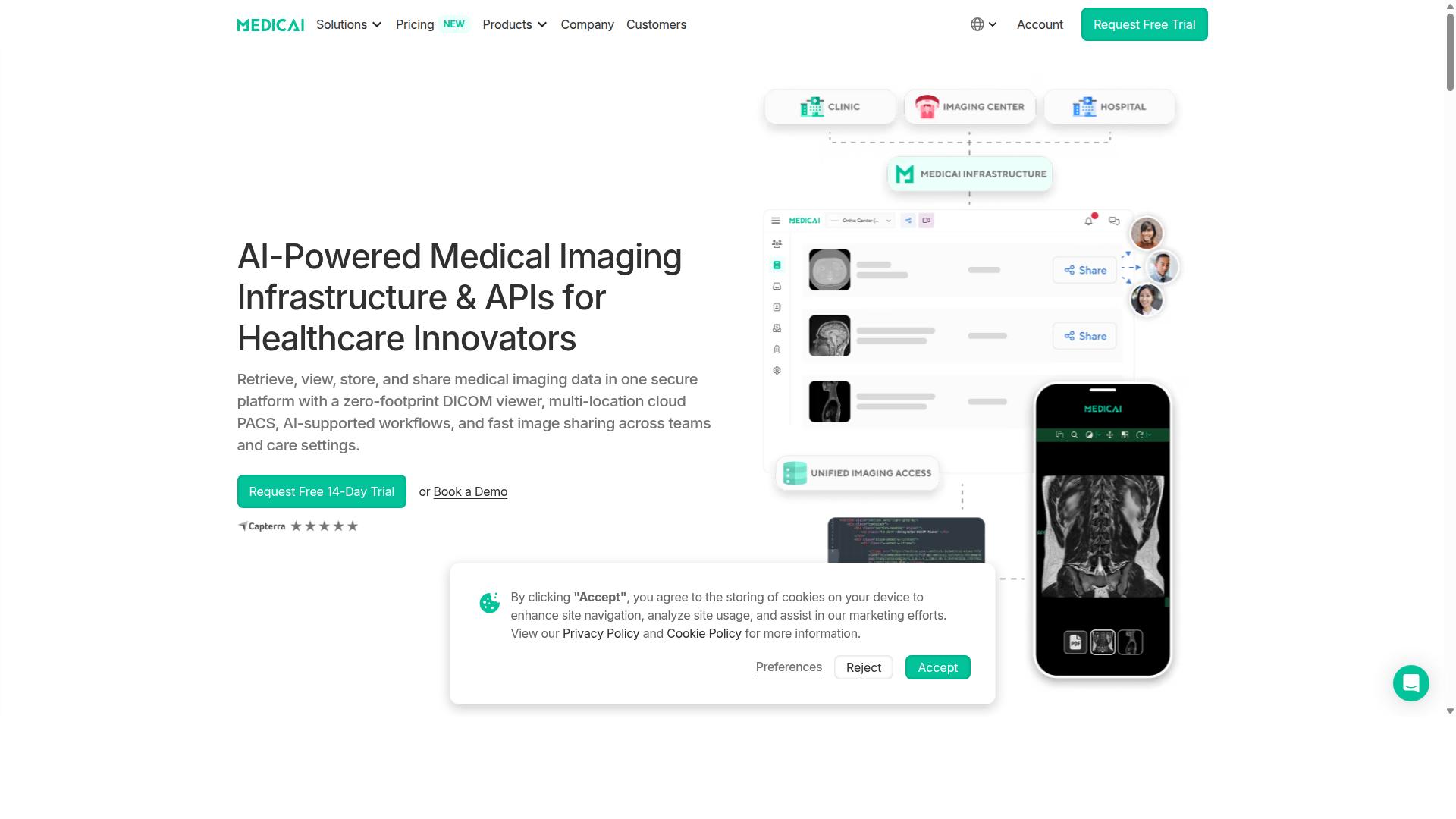
Medicai operates as a SaaS medical imaging platform that stores, retrieves, and shares DICOM studies through a single secure cloud interface. The platform functions as cloud-based medical imaging infrastructure that supports healthcare providers across multiple care settings.
The zero-footprint DICOM viewer eliminates local installation requirements. Healthcare facilities access imaging data directly through web browsers without additional software deployment or maintenance overhead.
Medicai currently supports 1.7M+ studies in storage across its cloud infrastructure. The platform scales on demand without hardware investments or capacity planning typical of traditional on-premise systems.
Integration with existing RIS occurs through HL7 and DICOM standards. These established protocols enable data exchange between Medicai and radiology information systems without custom development or proprietary interfaces.
Partnerships with Microsoft Azure and Amazon AWS provide the underlying infrastructure. The OHIF viewer technology supports the DICOM viewing capabilities within the platform.
Medicai delivers Imaging Infrastructure as a Service (IIaaS) for healthcare organizations. This approach focuses on modernizing medical imaging workflows and supporting interoperability between different systems and care teams.
What Is EMSOW?
EMSOW is a radiology workflow platform that combines RIS functionality with PACS capabilities, typically deployed as an on-premise or hybrid solution for imaging centers and radiology groups.
The system offers several core modules that handle patient scheduling, billing operations, and image storage. These components work together to create a unified environment for radiology practices that need coordination between administrative tasks and clinical imaging workflows.
Local server infrastructure forms the foundation of most EMSOW installations. This approach requires dedicated IT personnel to manage hardware maintenance, software updates, and system security protocols.
Many radiology practices choose this platform when they need tight connections between scheduling systems and imaging operations. The on-premise model gives organizations direct control over their data storage and processing environments.
Traditional deployment methods involve significant upfront investment in hardware and ongoing maintenance responsibilities. IT teams must handle regular system monitoring, backup procedures, and compliance requirements for patient data protection.
Features Compared
First sentence: Direct feature comparison reveals clear differences in deployment models and integration approaches between the two platforms.
Deployment flexibility determines how easily a practice can exchange imaging studies with referring physicians and hospital systems. Cloud-based platforms eliminate the need for local servers and ongoing IT maintenance. Traditional PACS often requires site-specific hardware and dedicated network connections.
Integration with existing RIS and radiology information system tools matters most for daily workflow. API availability and standard DICOM and HL7 support determine how fast new locations can connect. Teams should review vendor documentation before any data migration project begins.
Cloud PACS and Vendor Neutral Archive
Medicai's Cloud PACS functions as a vendor neutral archive with automatic backup and disaster recovery included in all plans.
The platform supports unlimited user accounts across every subscription tier. Storage starts at 500GB on the Starter plan and scales to 2TB on the Standard plan. Automatic backup services run continuously without extra configuration steps.
Platform capacity shows through 300,000-plus DICOM visualizations processed during the past year. Multi-site groups can add locations without rebuilding local infrastructure. Scalability reduces the risk of vendor lock-in when practices expand.
EMSOW follows a comparable cloud model, yet specific storage allocations and user limits remain less transparent in public materials. Both systems meet HIPAA compliance standards, but Medicai publishes clearer capacity figures for teams planning growth.
Multi-Location Integration and DICOM Gateway
Medicai's DICOM Gateway enables secure image transfer between facilities without VPN tunnels or dedicated network infrastructure.
The Standard plan includes one connected location out of the box. Additional sites require custom pricing based on volume and complexity. DICOM Gateway automates routing and handles HL7 message exchange between systems.
Typical on-premise PACS setups need site-to-site VPN configuration and local IT oversight. Cloud gateways remove these steps and shorten implementation timelines. Interoperability improves when new locations join without hardware changes.
EMSOW offers similar multi-site tools, yet public details about gateway automation and HL7 mapping stay limited. Medicai's documented approach gives clearer guidance for practices managing several imaging centers.
AI-Supported Workflows and Structured Reporting
Medicai provides API access for AI workflow integration, enabling third-party algorithm deployment directly within the imaging platform.
The system records 50 million-plus yearly API transactions, confirming stable performance under load. Partnerships with Rayscape.ai and MD.ai create an established ecosystem for radiology AI tools. Structured reporting appears inside the zero-footprint viewer for consistent documentation.
Cloud deployment delivers real-time AI result integration without local processing delays. Teams gain immediate access to algorithm outputs once studies finish uploading. Latency drops when processing happens on remote servers rather than on-site hardware.
EMSOW supports AI plugins through external connections, though specific transaction volumes and partner ecosystems receive less public detail. Medicai's documented API capacity and partner list provide clearer expectations for practices adding AI to daily reads.
Pricing Compared
Transparent monthly pricing versus traditional licensing models creates different cost structures for radiology practices evaluating these platforms. Monthly subscription fees eliminate large upfront costs that often accompany on-premise solutions.
Medicai offers three tiers with clear monthly billing. The Starter plan costs $249 per month and includes 500 GB of cloud storage with unlimited user accounts and no connected locations. The Standard plan costs $749 per month and provides 2 TB of cloud storage with unlimited user accounts and one connected location.
Yearly billing provides 15 percent savings. The Starter plan becomes $209 per month when paid annually, while the Standard plan becomes $639 per month. Enterprise pricing remains custom for practices needing multiple connected locations and additional external connections.
Implementation costs include a one-time $1,000 DICOM Gateway Setup fee per location. A 14-day trial of Starter plan features remains available without requiring a credit card. Per-study pricing options exist for enterprise customers.
Traditional EMSOW pricing typically follows a perpetual license model. This approach requires annual maintenance fees plus separate server infrastructure expenses that accumulate over time. Radiology departments must also budget for hardware replacement cycles and ongoing IT support.
Deployment timelines differ significantly between the two approaches. Medicai becomes operational within days because of its cloud-based architecture. On-premise alternatives often require months for server setup, network configuration, and staff training.
The subscription model shifts costs from capital expenditure to operational expenditure. Practices avoid hardware depreciation concerns and gain predictable monthly expenses that scale with storage needs rather than requiring capacity upgrades.
Who Should Choose Medicai
First sentence: Healthcare organizations prioritizing rapid deployment, minimal IT overhead, and scalable cloud infrastructure should evaluate Medicai.
Multiple location hospitals benefit from cloud deployment that eliminates server hardware investments. Imaging centers with expansion plans find predictable monthly costs easier to manage than traditional licensing structures.
Specialty practices in orthopedics, neurology, oncology, radiology, and cardiology often lack dedicated PACS administrators. These groups need solutions that reduce technical complexity while maintaining full RIS and PACS functionality.
Global operations require consistent performance across regions. Medicai serves international organizations including teleradiology services and telemedicine platforms that need reliable access without regional infrastructure differences.
Virtual care providers and clinical trial coordinators appreciate cloud scalability that grows with patient volume. Tumor boards and medical education organizations also use the platform to share imaging data across distributed teams.
Who Should Choose EMSOW
Radiology practices requiring extensive customization, maintaining dedicated IT staff, and preferring on-premise data control may find EMSOW suitable. Local server management allows these organizations to retain direct oversight of their infrastructure.
Groups with strict data residency requirements often need solutions that keep imaging data within specified geographic boundaries. On-premise deployment satisfies these regulatory demands without relying on external cloud providers.
Organizations needing highly customized workflow configurations beyond standard cloud platform capabilities benefit from EMSOW's flexibility. Legacy system integrations require on-site technical expertise that these practices typically maintain internally.
Radiology centers with established IT departments can handle the complexity of local installations and ongoing maintenance. Customization needs that exceed typical cloud offerings make this approach practical for specialized environments.
These practices often manage their own RIS PACS integration requirements through direct technical control. Data exchange protocols like DICOM and HL7 can be configured according to specific operational standards.
Implementation involves coordinating internal resources for deployment, training, and system updates. Interoperability challenges become manageable when experienced staff handle configuration directly rather than through external support channels.
The decision typically depends on whether the organization values complete infrastructure control over simplified cloud-based management. Technical complexity increases with on-premise solutions, requiring ongoing investment in staff expertise and system maintenance.
Final Verdict
Medicai's cloud-native approach with transparent pricing and proven scale makes it the stronger choice for most radiology practices seeking modern RIS/PACS integration. The platform processes over 1 million studies annually and maintains 1.7 million studies in storage. These figures demonstrate consistent performance across diverse imaging workflows.
Over 50 million API transactions show the system's reliability for data exchange between RIS and PACS components. Cloud deployment removes the need for on-premise servers and associated maintenance costs. Monthly pricing structures eliminate surprise infrastructure expenses while supporting predictable budgeting.
Deployment timelines tend to be shorter than traditional vendor implementations. Organizations avoid lengthy hardware procurement cycles and complex server configurations. Total cost of ownership typically decreases because cloud infrastructure replaces capital equipment purchases.
Practices evaluating both platforms should consider their current infrastructure and growth projections. Medicai offers direct access to implementation support through established contact channels. Practices can reach Medicai USA at +1 (832) 220 1035 or Medicai Romania at +40 316 305 875 for consultation on specific integration requirements.